 Burbank Appliance Repair
The Closet Laundry Problem
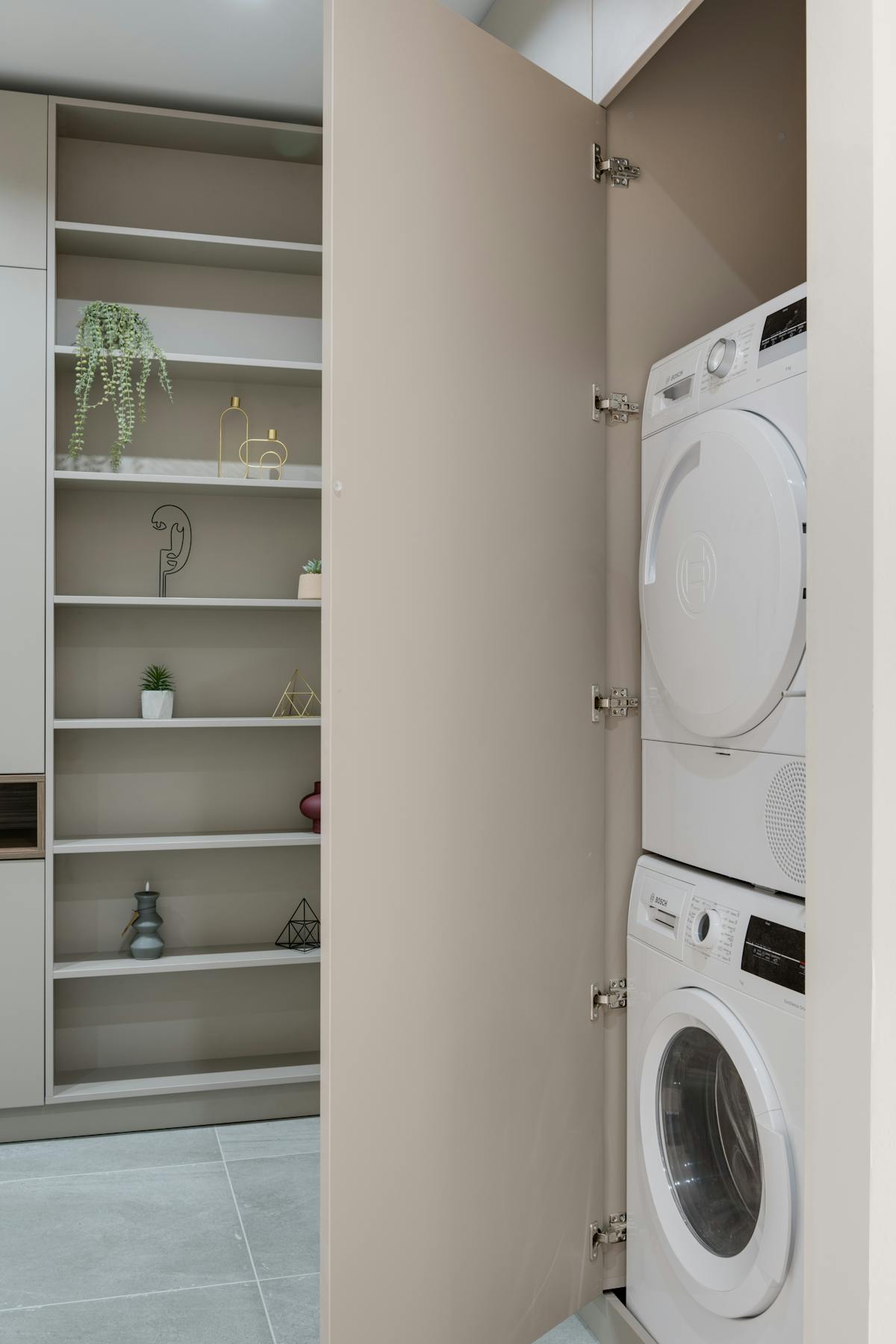
Drive the blocks between Alameda and Riverside near the studios and you’ll pass hundreds of apartments with the same setup: a stacked washer-dryer pair, or a single stackable unit, shoved into a hallway closet with a bifold door. Media District, the apartment corridors east of San Fernando Blvd downtown, the newer buildings on the edges of Magnolia Park — same story everywhere. Builders love these units because they fit in 27 inches of closet.
I work on more stacked laundry in Burbank than anywhere else we cover. And these units don’t fail the way a garage washer in a Toluca Lake house fails. They fail their own special way, and I want to walk you through what breaks, what it costs, and the renter-versus-landlord question that comes up on almost every one of these calls.
Why Stacked Units Break Differently
Three things are working against a closet laundry unit from day one.
Vibration has nowhere to go. In a stacked pair, the washer’s spin cycle transfers straight up into the dryer sitting on top of it. Every unbalanced load hammers the dryer’s drum bearings, the mounting brackets, and the stacking kit hardware. I’ve pulled dryers off washers and found the stacking brackets sheared clean through. The customer had no idea — the dryer was just resting there.
Venting is cramped or fake. A dryer wants a short, straight, rigid metal duct to the outside. What it usually gets in a Burbank apartment closet is three feet of crushed foil flex duct with two kinks in it, or worse, no vent at all. More on the fire risk below.
Heat builds up in the closet. Run a dryer for an hour inside a closed closet and the air in there hits temperatures the electronics were never designed to live in. The control boards sit right in that heat. Season after season, that cooks them.
The Three Failures I See Most
1. Dryer belts and idler pulleys — $180 to $260
The dryer sits on top, absorbing every vibration the washer sends up. The idler pulley — the little spring-loaded wheel that keeps tension on the drive belt — wears out fast in these units. First you hear a squeal or a thumping rumble. Then the belt snaps and the drum stops turning while the motor hums along happily.
On a Frigidaire or GE stacked unit, the belt and idler together run maybe $40-$60 in parts. The labor is the story, because getting into a dryer that’s six feet up in a closet is not like working on one in a laundry room. Figure $180-$260 all-in.
2. Washer drain pumps killed by lint and socks — $220 to $320
Baby socks, hair ties, and lint mats work their way past the tub seal and into the drain pump. The pump either jams outright — washer stops mid-cycle, full of water — or the impeller grinds itself down and the machine drains so slowly it throws an error code and quits.
I carry pumps for the common stacked models (the GE Unitized Spacemaker and the Frigidaire Laundry Center are everywhere in Burbank) on the truck. Sometimes I clear the blockage and the pump survives: that’s a cheap visit. If the pump’s toast, you’re at $220-$320 with the part.
3. Control boards cooked by closet heat — $280 to $450
The failure unique to closet installs. The board dies young — five, six years in — because it’s been baking every laundry day. Symptoms are the weird ones: buttons that stop responding, cycles that start and immediately quit, a display that flickers or goes blank. Boards run $120-$250 for the part, and some of the older Laundry Center boards are discontinued, which forces the replace conversation early.
If you have one of these units, leave the closet door open while it runs. That one habit adds years to the electronics. I tell every customer this and maybe a third of them do it.
The Lint Fire Risk Is Real
A kinked three-foot foil duct traps lint at every bend. Lint is kindling. The dryer’s heating element sits inches away from it. When I open up closet dryers in these buildings, I regularly find the duct interior half-blocked and the area behind the dryer coated in lint an inch thick.
Two warning signs: towels taking two cycles to dry, and the closet smelling hot after a load. Either one means stop using the dryer until someone looks at it. A vent cleaning and duct replacement is a $120-$180 job. A dryer fire in a wood-frame apartment building off Verdugo is a different order of problem entirely.
Renter or Landlord: Who Calls Us?
The question I get on the phone constantly. Here’s the short version for California.
If the washer-dryer came with the unit and it’s listed in your lease, it’s generally the landlord’s appliance to maintain. Appliances aren’t part of California’s strict habitability baseline the way heat and plumbing are, but if the lease includes them, the landlord owns keeping them working. Report the problem in writing (email or text, so there’s a record) and let the landlord or property manager schedule the repair. They pay, they call us, we coordinate access with you.
If you brought your own stackable into the unit, it’s yours. You call, you pay.
The gray zone is damage versus wear. A drain pump that ate your kid’s sock is arguably tenant-caused; a control board that died of old age is plain wear and tear. Most Burbank property managers I work with don’t fight over it — they just want the tenant to stop calling.
One tip for renters: don’t authorize a repair yourself expecting reimbursement without getting the landlord’s OK in writing first. I’ve watched that go sideways.
Why the Labor Costs More in a Closet
Unstacking a laundry pair inside a 30-inch closet is a genuine two-person job. The dryer weighs 130-plus pounds and sits above shoulder height, with maybe two inches of clearance per side. On a house call I can often slide a machine out solo. In a Media District closet, I’m bringing a second tech, and that shows up in the labor.
Expect stacked-unit repairs to run $50-$100 more than the same repair on side-by-side machines. Not a Burbank thing — a physics thing.
Repair vs. Replacing the Pair
A new stacked laundry center runs $1,400-$1,900 installed, and true stacked pairs (separate washer and dryer with a stacking kit) run more. Against that number, a $250 pump or a $220 belt job is easy math: repair.
Where I tell people to replace: a unit past 12 years that needs a board nobody makes anymore, or a washer with a failing transmission or cracked outer tub. Those repairs push past $500 on a machine near end of life, and the 50% rule applies just like it does to anything else.
The No-Vent Closet: Consider a Heat-Pump Dryer
Some older Burbank buildings have laundry closets with no vent path to the outside at all — someone just aimed the duct into the wall cavity. If that’s your situation, a ventless heat-pump dryer is worth a real look when the old unit dies. No duct needed, they run cool (kinder to that closet), and they pull about a third of the electricity. Trade-offs: longer dry times, a condensate tank to empty, and a $1,000-$1,400 price for a compact unit. For a closet that can’t be vented safely, it’s the right answer more often than not.
If Your Closet Unit Is Acting Up
We work on stacked and combo laundry units all over Burbank — GE, Frigidaire, Whirlpool, LG, Samsung, and the compact European brands. Call (818) 264-4269 and tell us the model and what it’s doing. The $49 service call is waived with repair, and yes, we bring the second set of hands for closet jobs. If you’re a renter, we’re happy to coordinate directly with your landlord or property manager — we do it every week.